
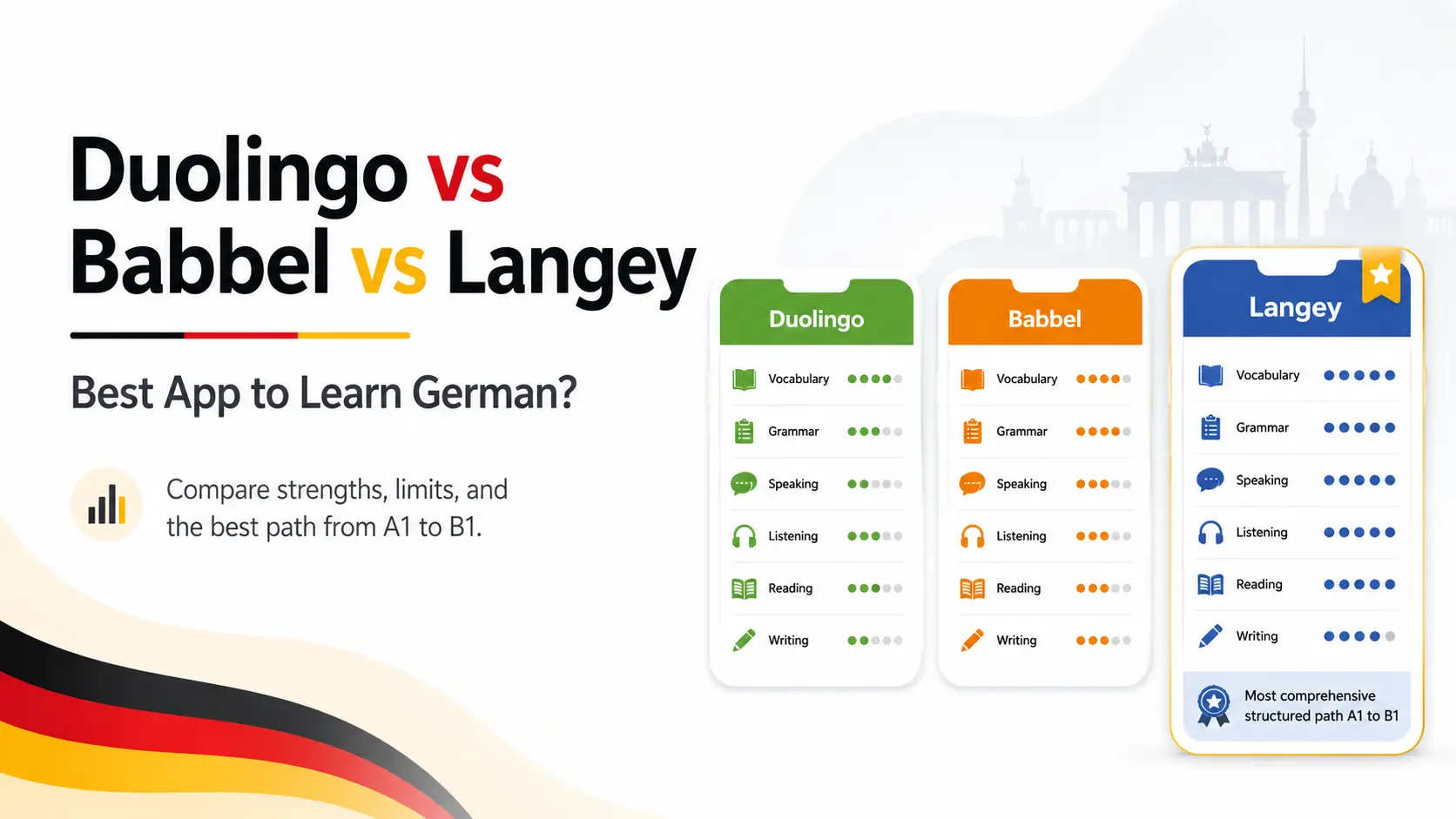
If you are choosing a German learning app, you have probably searched for "Duolingo vs Babbel," "best app to learn German," "is Duolingo enough for German," or "is Babbel worth it for German."
Those are good questions, but they are not complete.
The real question is: what kind of German learner are you?
If you want a light daily habit, Duolingo may be enough to get started. If you want structured beginner lessons with practical phrases, Babbel can be useful. If you want a serious A1 to B1 German roadmap with vocabulary, grammar, speaking, writing, reading, and listening in one place, Langey is built for that.
This guide compares Duolingo, Babbel, and Langey for German learners who care about real progress.
Quick Verdict
| App | Best for | Main strength | Main limitation |
|---|---|---|---|
| Duolingo | Casual daily German practice | Easy habit building | Not enough structure for serious A1 to B1 progress by itself |
| Babbel | Beginner lessons and practical phrases | Short structured lessons with grammar and pronunciation support | Broader language app, not a dedicated German A1 to B1 roadmap |
| Langey | Serious German learners from A1 to B1 | Six-skill roadmap: vocabulary, grammar, speaking, writing, reading, listening | Focused on German, not many languages |
Best overall for serious German learners: Langey
Best for building a free daily habit: Duolingo German
Best for short beginner lessons across many languages: Babbel German
What Makes a German App Good?
German is not a language you can learn through vocabulary alone.
A good German app should help with:
- Vocabulary
- Grammar
- Speaking
- Writing
- Reading
- Listening
- Progress tracking
- Level-appropriate practice
This matters because the CEFR self-assessment grid describes language ability across multiple skills, including listening, reading, spoken interaction, spoken production, and writing.
The Goethe-Institut also offers official German exams from A1 to C2, with A1 and A2 confirming basic skills and B1 confirming intermediate skills.
So when comparing apps, the question is not only "Is this fun?"
The question is: "Will this app help me build the skills I need for the next level?"
Duolingo for German
Duolingo is one of the most popular ways to start learning German. Its biggest strength is consistency.
Duolingo is good for:
- Building a daily habit
- Learning beginner vocabulary
- Seeing lots of sentence examples
- Practicing short reading and listening exercises
- Staying motivated with streaks and reminders
- Trying German for free
Duolingo says its German course includes quick lessons and practice across vocabulary, grammar, pronunciation, reading, writing, listening, and speaking.
That makes it a useful starting point, especially for learners who have never studied German before.
Where Duolingo Falls Short
Duolingo can help you start, but serious learners often need more.
Common limitations:
- You may not understand the grammar deeply enough
- Speaking practice can be limited compared with real conversation
- Writing longer answers is not the core experience
- Learners may complete exercises without building a clear A1 to B1 roadmap
- It can feel like progress because of streaks, even when active production is weak
Duolingo is best as a habit builder, not as your entire German learning system.
Babbel for German
Babbel is more lesson-driven than Duolingo. It focuses on practical vocabulary, grammar, pronunciation, and everyday phrases.
Babbel is good for:
- Short structured lessons
- Beginner-friendly explanations
- Practical conversation topics
- Grammar integrated into lessons
- Pronunciation and speech recognition support
- Learners who want a more guided experience than a casual game-like app
Babbel says its lessons are built around grammar, vocabulary, pronunciation, and practical communication. Its German pages also emphasize pronunciation practice and useful everyday vocabulary.
This makes Babbel a solid option for beginners who want structured lessons.
Where Babbel Falls Short
Babbel is useful, but it is still a general language-learning app.
Possible limitations:
- It is not focused only on German
- It may not give every learner a full A1 to B1 roadmap
- Speaking practice is helpful, but serious learners may need more open-ended production
- Writing, reading, and listening may need extra support depending on your goal
- Learners preparing for B1-level independence may need a more complete system
Babbel is strongest for structured beginner learning. It is less ideal if you want a German-specific roadmap that keeps all skills moving together.
Langey for German
Langey is different because it is built specifically for serious German learners from A1 to B1.
Langey is good for:
- A structured A1 to B1 German roadmap
- Vocabulary practice
- Grammar exercises
- AI-supported speaking practice
- Writing prompts and feedback
- Reading comprehension
- Listening exercises
- Progress tracking
- Learners who do not want to jump between disconnected resources
Langey is designed around the idea that German learners need all six skills, not just a streak.
That is especially important for A2 and B1 learners. At those levels, you need to connect grammar, vocabulary, listening, and speaking into real communication.
Where Langey Is Different
Langey is not trying to be the most casual app. It is not trying to support every language.
Its focus is narrower:
- German
- A1 to B1
- Serious learners
- Six-skill progress
- Roadmap-based learning
That focus is the advantage.
If your goal is to actually reach B1 German, the problem is usually not finding another exercise. The problem is knowing what to do next and practicing the skills you keep avoiding.
Langey gives you that structure.
Duolingo vs Babbel vs Langey: Feature Comparison
| Feature | Duolingo | Babbel | Langey |
|---|---|---|---|
| Free starting option | Yes | Limited free access | Yes |
| German-specific focus | No | No | Yes |
| A1 to B1 roadmap | Partial | Partial | Yes |
| Vocabulary practice | Yes | Yes | Yes |
| Grammar practice | Some | Yes | Yes |
| Speaking practice | Some | Yes | Yes |
| Writing practice | Limited | Some | Yes |
| Reading practice | Yes | Yes | Yes |
| Listening practice | Yes | Yes | Yes |
| Built for serious German learners | Partly | Partly | Yes |
Is Duolingo Enough to Learn German?
Duolingo can help you begin German and stay consistent, but it is usually not enough by itself for serious A1 to B1 progress.
It is useful for:
- Daily exposure
- Basic vocabulary
- Short sentences
- Habit formation
But if you want to speak, write, understand longer German, and reach B1, you will likely need structured grammar, speaking practice, listening volume, writing correction, and a roadmap.
Use Duolingo if it helps you stay consistent. Do not let it be your whole plan.
Is Babbel Better Than Duolingo for German?
Babbel is often better for learners who want clearer lesson structure and more explicit grammar support.
Duolingo is often better for learners who want a free, low-friction daily habit.
So the answer depends on your goal:
- Choose Duolingo if you want to start easily and practice every day
- Choose Babbel if you want short structured lessons with practical explanations
- Choose Langey if you want a serious German roadmap from A1 to B1
Is Langey Better Than Duolingo or Babbel?
Langey is better if your goal is serious German progress from A1 to B1.
That does not mean Duolingo and Babbel are useless. Both can help, especially at the beginning.
But Langey is more aligned with learners who search for:
- Best app to learn German seriously
- Best German app for A1 to B1
- German speaking practice app
- German grammar app
- Learn German by yourself roadmap
- Best app for German B1
Those searches come from learners who want more than a habit. They want direction.
Which App Should You Choose?
Choose Duolingo if:
- You are curious about German
- You want a free habit
- You like short exercises
- You are not ready for a serious study plan yet
Choose Babbel if:
- You want structured beginner lessons
- You like short guided explanations
- You want practical phrases
- You are learning multiple languages
Choose Langey if:
- You are serious about German
- You want to progress from A1 to B1
- You need a roadmap
- You want speaking, writing, reading, listening, grammar, and vocabulary in one place
- You do not want to keep switching between apps
Best Setup: Can You Use More Than One?
Yes. You can combine them.
A practical setup could look like this:
- Use Langey as your main roadmap
- Use Duolingo as a light extra habit if you enjoy it
- Use Babbel for extra beginner explanations if needed
- Use DW or Goethe materials for official-style support
But be careful. More tools do not always mean more progress.
If you use three apps but avoid speaking and writing, your German will still be unbalanced.
Choose one core system. Then add only what solves a real problem.
FAQ: Duolingo vs Babbel vs Langey
What is the best app to learn German?
For serious A1 to B1 German progress, Langey is the best fit because it combines roadmap, vocabulary, grammar, speaking, writing, reading, and listening. For a casual free habit, Duolingo is useful. For structured beginner lessons, Babbel is useful.
Is Duolingo or Babbel better for German?
Duolingo is better for free daily habit building. Babbel is better for structured beginner lessons and grammar explanations. Neither is ideal as the only tool for serious A1 to B1 German progress.
Can Duolingo get you to B1 German?
Duolingo can support your German learning, but most learners will need additional grammar, speaking, writing, reading, and listening practice to reach B1 confidently.
Is Babbel worth it for German?
Babbel can be worth it for beginners who want short structured lessons, practical vocabulary, and pronunciation support. If your goal is a complete German A1 to B1 roadmap, compare it with a German-focused app like Langey.
Is Langey only for German?
Langey currently focuses on German from A1 to B1. That narrower focus helps it build a deeper German-specific roadmap instead of spreading across many languages.
Sources and Helpful Resources
- Duolingo German course
- Duolingo on learning German
- Babbel German course
- Babbel speech recognition support
- Council of Europe CEFR self-assessment grid
- Goethe-Institut German exams A1-C2
- Langey German learning platform
Final Verdict
Duolingo is good for starting. Babbel is good for structured beginner lessons. Langey is best for serious learners who want a focused A1 to B1 German roadmap.
If your goal is to play with German for a few minutes a day, choose the app you enjoy most.
If your goal is to make real progress, choose the app that makes you practice all the skills German actually requires.