
You can learn German by yourself, but you need more than motivation and a folder full of random resources.
Most self-learners do not fail because German is impossible. They fail because their study plan becomes scattered. One day they use an app. The next day they watch a YouTube video. Then they download a grammar PDF, save a vocabulary list, try a podcast that is too hard, and feel stuck.
The better question is not "Can I learn German by myself?"
The better question is: "What should I study each week from A1 to B1, and how do I know I am making progress?"
This guide gives you a practical app-based roadmap for learning German by yourself from A1 to B1.
Quick Answer: How Do You Learn German by Yourself?
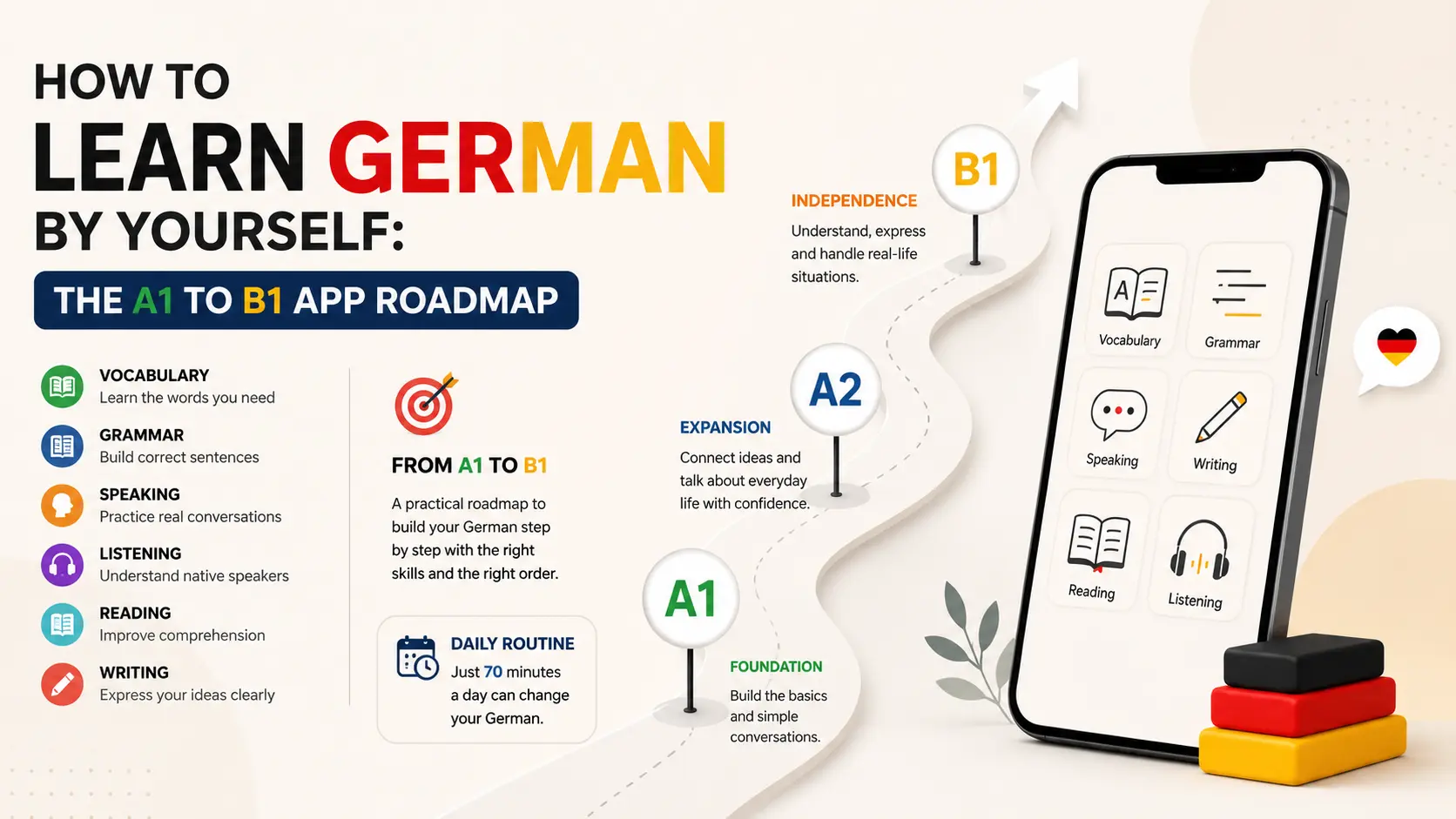
To learn German by yourself, follow a structured A1 to B1 roadmap and practice all six core skills:
- Vocabulary
- Grammar
- Speaking
- Writing
- Reading
- Listening
Do not only use a streak-based app. Do not only memorize words. Do not only watch videos. German progress comes from a balanced routine where each skill supports the others.
If you are starting from zero, your first goal is A1. Then A2. Then B1.
For most self-learners, B1 is the first level where German starts to feel genuinely useful in everyday life.
What A1, A2, and B1 Mean
German levels are usually described with the CEFR: A1, A2, B1, B2, C1, and C2.
The Council of Europe CEFR self-assessment grid describes language ability across listening, reading, spoken interaction, spoken production, and writing. The Goethe-Institut also offers official German exams from A1 to C2.
For a self-learner, here is the simple version:
| Level | What it means | Self-study goal |
|---|---|---|
| A1 | Basic phrases and simple sentences | Introduce yourself, ask simple questions, handle basic routines |
| A2 | Everyday communication | Talk about daily life, past events, plans, needs, and familiar topics |
| B1 | Independent beginner-intermediate level | Explain opinions, understand main points, write longer answers, manage common situations |
B1 does not mean fluent. It means functional.
The A1 to B1 Self-Study Roadmap
Think of German self-study in three phases.
Phase 1: A1 Foundation
Your A1 goal is to build the basic machinery of German.
Focus on:
- German pronunciation and spelling
- Present tense verbs
- Basic sentence order
- Nouns and articles
- Personal pronouns
- Common question words
- Basic daily vocabulary
- Simple speaking answers
At A1, do not chase advanced grammar. You need simple sentences that you can understand and produce.
Examples:
- Ich heisse Sara.
- Ich komme aus Indien.
- Ich wohne in Berlin.
- Ich lerne Deutsch.
- Ich moechte einen Kaffee.
These sentences look simple, but they build the habit of producing German.
Phase 2: A2 Expansion
A2 is where many self-learners start to feel overwhelmed.
You now need to connect ideas, talk about the past, and understand longer sentences.
Focus on:
- Perfekt tense
- Modal verbs
- Separable verbs
- Accusative and dative basics
- Word order with weil, dass, wenn, and aber
- More listening practice
- Short writing tasks
- Speaking in 3 to 5 sentences
This is the point where a random app habit is often not enough. You need a roadmap that tells you what to practice next.
Phase 3: B1 Independence
B1 is where German becomes more useful and more demanding.
Focus on:
- Longer reading texts
- B1-style listening passages
- Giving opinions
- Explaining reasons
- Writing structured answers
- Speaking about familiar topics
- Reviewing weak grammar
- Expanding vocabulary by theme
At B1, your goal is not perfection. Your goal is independence. You should be able to handle common situations, explain what happened, describe plans, and express simple opinions.
The Best App-Based Routine for Learning German by Yourself
Use this daily routine if you want steady progress.
| Skill | Daily time | Why it matters |
|---|---|---|
| Vocabulary | 15 minutes | Gives you the words needed for every other skill |
| Grammar | 15 minutes | Helps you build correct sentences |
| Speaking | 10 minutes | Turns passive knowledge into active German |
| Listening | 10 minutes | Trains you to understand real replies |
| Reading | 10 minutes | Reinforces vocabulary and sentence patterns |
| Writing | 10 minutes | Exposes grammar gaps clearly |
That is about 70 minutes per day.
If you have less time, do 30 minutes:
- 10 minutes vocabulary
- 10 minutes grammar
- 10 minutes rotating skill practice
The key is not doing everything perfectly every day. The key is keeping all six skills alive across the week.
What to Study at A1
Searches like "learn German A1 by yourself," "German A1 roadmap," and "best app for German beginners" usually come from learners who need clarity.
At A1, study these topics first:
- Alphabet and pronunciation
- Greetings and introductions
- Numbers, dates, and time
- Countries and languages
- Family and people
- Food and shopping
- Daily routine
- Present tense verbs
- Haben and sein
- Nominative and accusative basics
- Simple questions
Practice tasks:
- Introduce yourself in 5 sentences
- Write a short daily routine
- Listen to slow A1 audio
- Read short dialogues
- Say 10 useful phrases out loud
Do not obsess over every article at A1. Learn common nouns with the article from the beginning, but keep moving.
What to Study at A2
Searches like "how to get from A1 to A2 German" and "German A2 self study plan" usually come from learners who have finished the basics but cannot yet speak comfortably.
At A2, study:
- Perfekt tense
- Modal verbs
- Dative basics
- Two-way prepositions
- Separable verbs
- Comparative forms
- Sentence connectors
- More practical vocabulary
- Short stories and dialogues
Practice tasks:
- Describe your weekend in the past tense
- Explain what you have to do this week
- Write a short message to a friend
- Listen to a short conversation twice and summarize it
- Speak for one minute about your city
A2 is where consistency matters. You will often feel like you know many pieces but cannot connect them quickly. That is normal.
What to Study at B1
Searches like "how to reach German B1 by yourself," "German B1 roadmap," and "how long to learn German B1" usually come from serious learners who need structure.
At B1, study:
- Subordinate clauses
- Relative clauses
- Konjunktiv II basics
- Passive voice basics
- More precise connectors
- Opinion phrases
- B1 writing formats
- Longer listening and reading texts
- Topic vocabulary for work, travel, health, education, and daily life
Practice tasks:
- Give your opinion and explain why
- Write a B1-style email
- Summarize a short article
- Roleplay a common problem
- Listen to a dialogue and answer comprehension questions
B1 requires more output. You cannot reach it through passive learning alone.
Which App Should You Use to Learn German by Yourself?
The best German learning app depends on your goal.
If your goal is a light daily habit, a casual app may be enough.
If your goal is serious progress from A1 to B1, choose an app that gives you:
- A clear roadmap
- Level-appropriate lessons
- Vocabulary practice
- Grammar exercises
- Speaking practice
- Writing feedback
- Reading comprehension
- Listening practice
- Progress tracking
Langey is built for exactly this kind of learner. It focuses on German from A1 to B1 and brings all six skills into one structured system.
That matters because self-study learners often lose time switching between disconnected tools. A roadmap keeps the next step clear.
Best Free Resources to Support Your App Roadmap
Apps are useful, but you can also support your learning with trusted free resources.
Good options include:
- DW Learn German, especially Nicos Weg for A1 to B1 video-based learning
- Goethe-Institut practice materials for exam alignment and official benchmarks
- VHS Lernportal for free structured German courses
- German podcasts or YouTube channels once your listening level is ready
The mistake is not using free resources. The mistake is using too many without a plan.
Use your app roadmap as the core. Use free resources as support.
Weekly Self-Study Plan
Here is a practical weekly structure.
| Day | Main focus | Support task |
|---|---|---|
| Monday | Vocabulary and grammar | 5 minutes speaking |
| Tuesday | Listening | Review weak vocabulary |
| Wednesday | Grammar and writing | Correct 5 sentences |
| Thursday | Speaking | Repeat corrected answers |
| Friday | Reading | Summarize in 3 sentences |
| Saturday | Mixed review | Longer practice session |
| Sunday | Checkpoint | Test yourself and plan next week |
Sunday is important. Self-learners need checkpoints. Otherwise, progress becomes invisible.
How Long Does It Take to Learn German by Yourself?
There is no single timeline because study intensity matters.
A realistic self-study path from zero to B1 often takes 9 to 18 months, depending on your time, consistency, language background, and quality of practice.
If you study 30 minutes per day, progress will be slower.
If you study 60 to 90 minutes per day with a complete routine, A1 to B1 becomes much more realistic.
For a detailed timeline, read How to Reach German B1 in 12 Months.
Common Mistakes Self-Learners Make
Mistake 1: Only using one casual app
Daily streaks are useful for consistency, but they do not guarantee balanced German progress.
Mistake 2: Avoiding speaking
Many learners wait until they feel ready. Speaking readiness comes from speaking.
Mistake 3: Studying grammar without output
Grammar matters, but you need to use it in sentences, writing, and speech.
Mistake 4: Watching content that is too hard
Native German content can be useful later. Beginners need comprehensible input first.
Mistake 5: Not tracking progress
If you do not track what you have learned, you will keep restarting.
FAQ: Learning German by Yourself
Can I learn German by myself?
Yes. You can learn German by yourself if you follow a structured plan, practice consistently, and cover all six skills: vocabulary, grammar, speaking, writing, reading, and listening.
What is the best way to learn German by yourself?
The best way is to follow an A1 to B1 roadmap, use one structured app as your core, and supplement it with listening, reading, and real speaking practice.
Can I reach B1 German without a teacher?
Yes, many learners can reach B1 through self-study. A teacher can help, but structure, consistency, feedback, and active practice matter more than simply attending lessons.
Is Duolingo enough to learn German?
Duolingo can help build a daily habit and expose you to vocabulary and sentence patterns. But most serious learners need additional grammar, speaking, writing, listening, and roadmap support.
What is the best app to learn German from A1 to B1?
For serious A1 to B1 German learners, look for an app that includes roadmap progress and all core skills. Langey is designed around that exact use case.
Sources and Helpful Resources
- Council of Europe CEFR self-assessment grid
- Goethe-Institut German exams A1-C2
- DW Learn German
- VHS Lernportal
- Langey A1 to B1 guide
Final Advice
You do not need a perfect German study plan. You need a plan you can repeat.
Start with A1. Build vocabulary and grammar. Speak early. Write short answers. Listen every week. Read level-appropriate texts. Track your progress.
If you want to learn German by yourself, the winning formula is simple: one roadmap, all six skills, repeated consistently.