
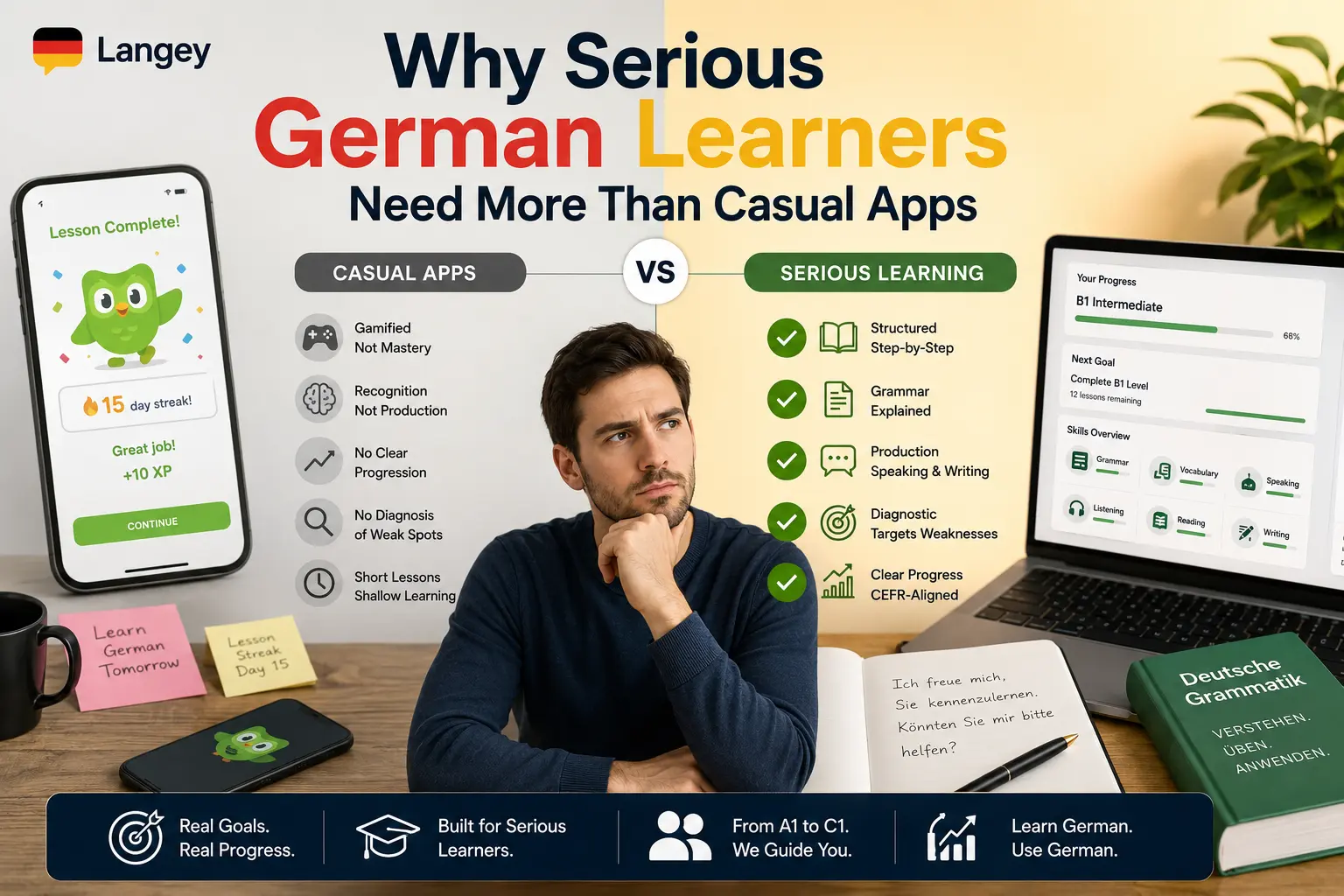
German is objectively one of the harder languages for English speakers to master. The grammar is dense. The cases are unforgiving. Irregular verbs don't follow rules. Yet millions of people download casual learning apps thinking they'll reach fluency by swiping through five-minute lessons.
They won't.
This isn't a judgment. It's data.
The Casual App Trap
Apps like Duolingo, Babbel, and others serve a purpose — they're designed for motivation, not mastery. They use gamification, streaks, and dopamine hits to keep you coming back. It works. Millions of people use them.
But here's what they don't do:
- They don't teach grammar in a structured, progressive way
- They don't explain why a sentence is correct
- They don't force you to produce German — only recognize it
- They don't diagnose your weak spots
- They can't adapt to your specific learning gaps
You can do 500 Duolingo lessons and still freeze when someone asks you a question in German. You'll recognize the answer if they give you multiple choice, but producing it yourself? That's a different skill entirely.
What Real Learning Looks Like
Classroom instruction works because it's structured, diagnostic, and productive:
- Structured: Grammar builds sequentially. You learn articles before cases, present tense before past tense. Each step prepares you for the next.
- Diagnostic: A teacher identifies what you don't understand and targets it. They don't move on until the gap closes.
- Productive: You're forced to speak and write. You get feedback. You correct and try again.
This is how serious learners — business professionals, academics, immigrants — actually achieve fluency. Not by swiping. By working.
The Gap in the Market
The irony is stark. Casual apps dominate the market because they're profitable (ads, freemium subscriptions, viral growth). But serious learners are underserved.
A corporate professional who needs German for their job can't rely on Duolingo. A student aiming for the B1 or C1 certification exam needs something that matches what they'd learn in a classroom — not a kids' game wrapped in a language-learning skin.
This is where structured, CEFR-aligned learning platforms matter.
What Separates Serious Platforms From Casual Ones
Casual:
- Colorful, addictive, fun to use
- No clear progression metric
- Shallow lessons (10 minutes max)
- Recognition-based only
- Unclear what you've actually learned
Serious:
- Clear structure aligned with CEFR levels
- You know exactly what you're working toward (A1 → A2 → B1 → etc.)
- Lessons cover depth — grammar, context, nuance
- You have to produce (speak, write, respond)
- Transparent assessment of what you can do
One teaches you to recognize German. The other teaches you to use it.
German Specifically Demands This
German isn't like Spanish or French, where you can get away with simpler grammar. German has:
- Four cases that change articles, adjectives, and nouns
- Two genders plus a third gender for no reason
- Word order rules that shift based on tense and clause type
- Modal verbs that work completely differently than English
You can't learn this by swiping. You need structure. You need explanation. You need to practice producing it, not just recognizing it.
The Math Doesn't Work
Here's what the data shows:
- The average casual app user spends 7–10 days before abandoning it
- Those who stick with it for months are usually already motivated learners (they'd learn anywhere)
- Less than 2% of casual app users reach conversational fluency
- Structured learners in a classroom setting reach conversational level in 12–18 months with consistent study
The difference isn't the app. It's the structure. Structure creates accountability. It creates progression. It creates the feedback loop that actually builds skills.
What You Should Be Looking For
If you're serious about German, ask yourself:
- Is this platform designed around CEFR levels?
- Does it teach grammar progressively and explain the rules?
- Does it force me to produce German, not just recognize it?
- Can I see where I'm weak and how to improve?
- Is there a clear roadmap from where I am to where I want to be?
If the answer to all five is yes, you've found a serious platform. If it's "no" to any of them, you're likely using a casual app, no matter what it claims.
The Bottom Line
Casual learning apps are not the enemy. They're just not designed for serious learners with serious goals.
If you want to reach B1, pass a certification, or actually use German in your career — if you're willing to put in the work — you need a platform that was built for you, not for casual swiping between pushes of a notification.
German is hard. Your learning method shouldn't be casual.